Dry Vocal vs Live Preverb
A lead line, then the same bars with a reversed swell rising into every phrase.
Case No. 002 — Open
v1.1.1 · Mac + WindowsA reverb answers after the sound. Backtrace files its report first. Real reversed-reverb swells that rise out of silence and land exactly on the note that caused them — live on the insert, synced to your DAW, with a capture engine for printing reverse FX you can drag anywhere.
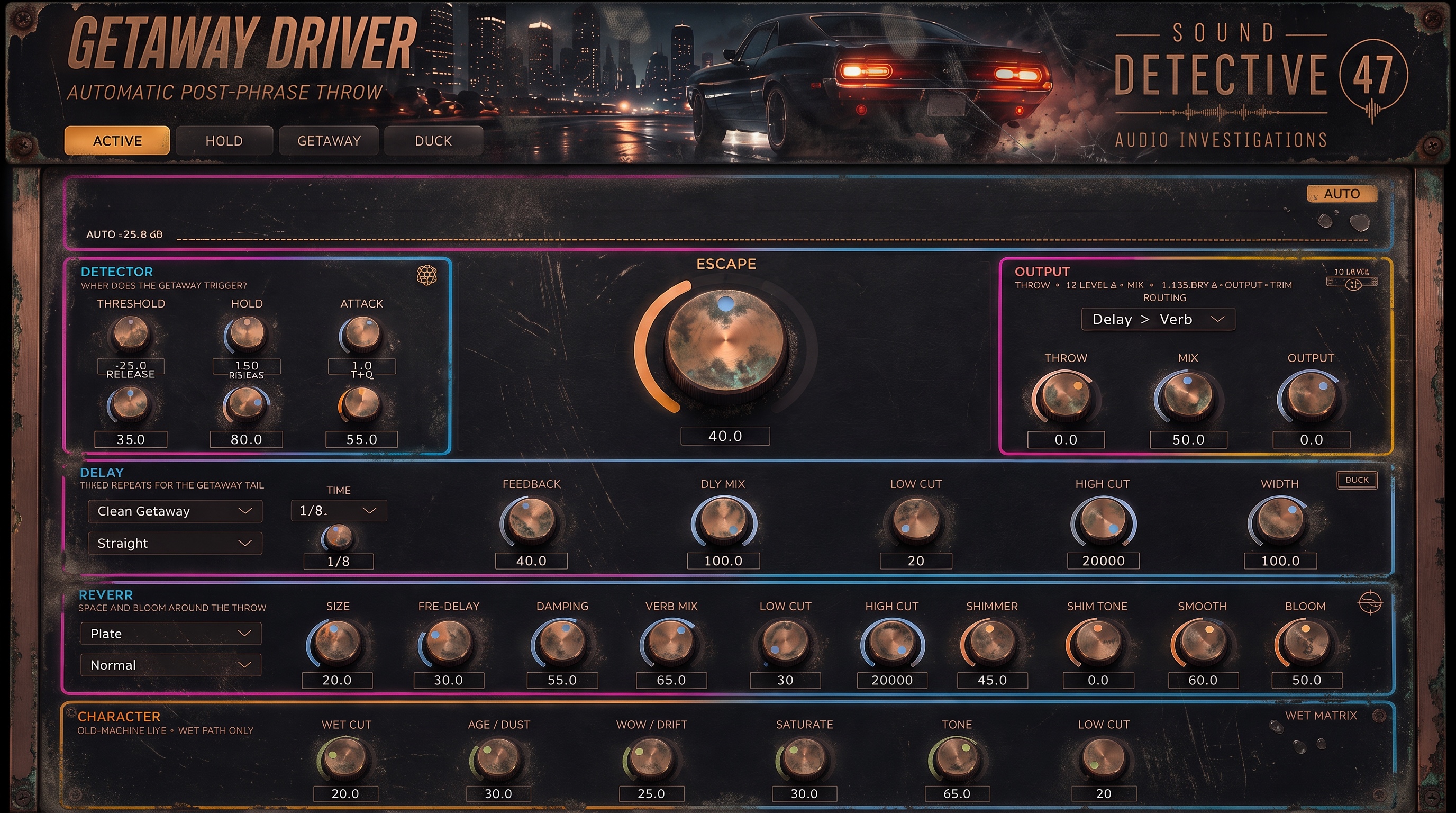
Or take both edges of the phrase: Backtrace + Getaway Driver for $79.
macOS 12+ · Apple Silicon & Intel · Windows 10/11 (VST3) · AU + VST3
The reverse-reverb trick is decades old and still magic — but the workflow never was: bounce the clip, reverse it, print a reverb, reverse that, line it up by hand, and repeat every time the arrangement moves. Backtrace does the whole investigation in real time, and when you want the printed version, it hands you the WAV.
Three exhibits, one rule: the dry take and the same bars through Backtrace — level-matched, one switch apart, named for the factory preset that makes it.
A lead line, then the same bars with a reversed swell rising into every phrase.
A clean figure, then each chord announced by its own reversed tail.
A snare fill, then a printed reverse swell pulling the section into the downbeat.
The exhibits are being printed at the studio now — dry/wet pairs land here as they're finished.
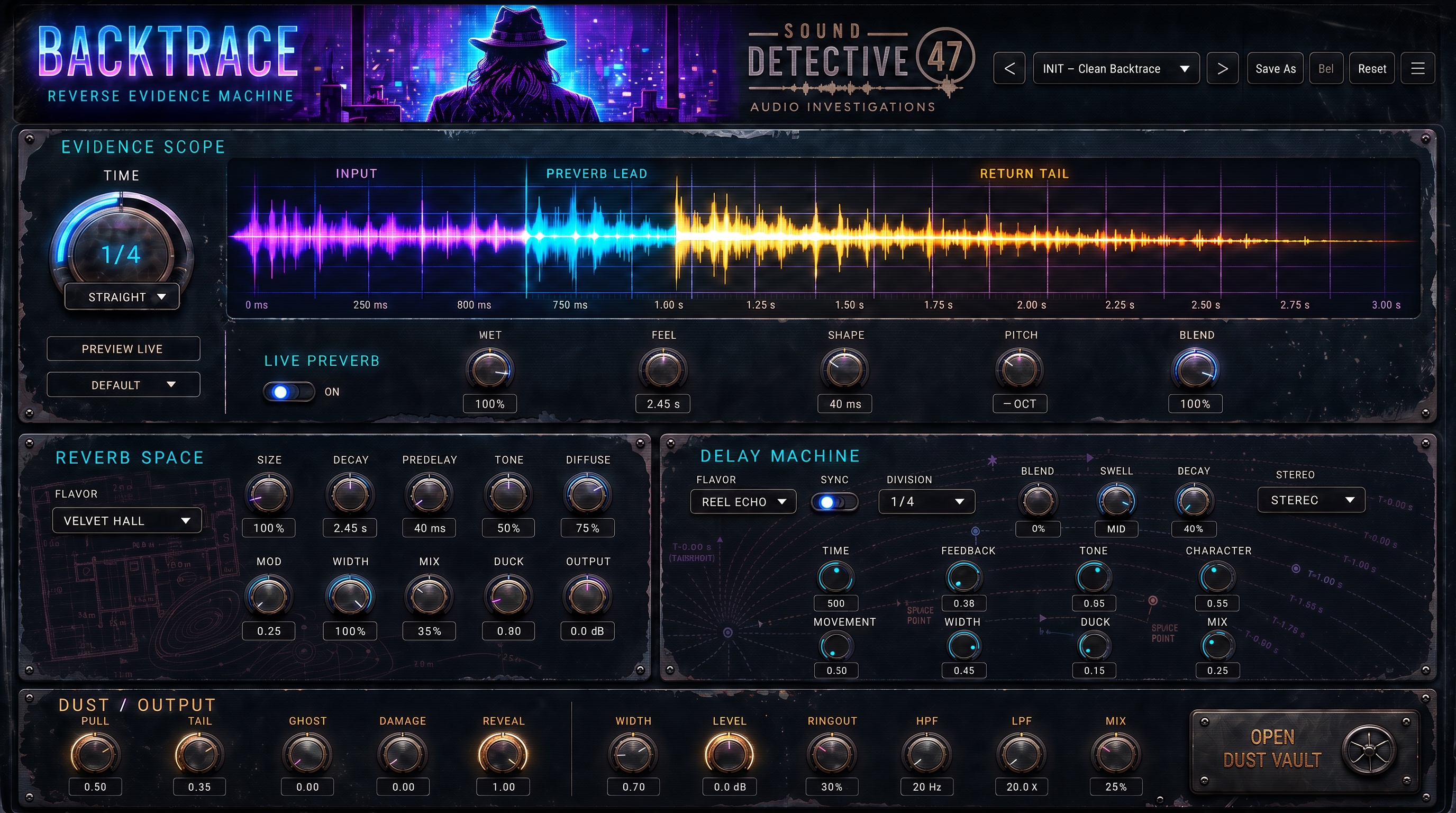
Two engines, two racks, one console — from the operations manual.
Insert it, press play, and it happens in real time: a reversed swell that rises out of silence and lands exactly on the note that caused it. The swell is built from a real reverb tail — the plugin renders the kernel from the room you chose and convolves with it reversed, locked to your DAW’s tempo. No bouncing, no flipping, no re-printing when the arrangement changes.
The second engine is a workstation: drag a word, a hit, or a phrase straight in — from Finder or straight off your DAW’s arrange page — grow a real FX tail from it, reverse the tail into a swell, audition it forward or reversed, then print the result and drag it out as a WAV, sample-accurate.
The reverb plate that builds your swell: Velvet Hall, Modern Space, Ghost Shimmer, Phantom Plate, and Rust Spring — each flavor owns its full sound with its own set of deep controls.
A second tail layer from six machines: Reel Echo (multi-head tape with wow, flutter, and degradation), Digital Pedal, Magnetic Drum, Tape Witness, Cold Rack, and Vault Delay — routable six ways around the reverb (swell, series either direction, parallel, post color).
Global macros that shape the printed swell: Pull, Tail, Ghost, Damage, Reveal, Width, Ringout, and Swell Level — with mono-safe M/S width and output filters. Thirty-one of the musical controls are real host parameters, so every move automates.
Two eight-slot evidence banks: Source Slots for what you drag in, Printed Swells for what you render. Slots rename, clear, and drag out as WAV files — the session’s reverse experiments stay filed, not lost.
The preset browser ships organized by job — Live Preverb, Vocal Throws, Reverse Blooms, Drum FX, Guitar Swells, Synth/Cinematic, Dirty Vault — with names that say what they do: Vocal Lift, Guitar Swell, Snare Halo, Big Riser, Tight Transition, Cathedral Rise, Ghost Vocal Rise, Tape Witness Slapback, Reverse Tail Pull, Full Reverse Evidence, and more.
Start the swell ahead of the downbeat so the rise finishes exactly where the section begins.
Route the delay ahead of the reverse so the swell arrives with rhythm, not just wash.
Ride the Reveal macro through a transition — the swell uncovers itself into the drop.
Eight field techniques ship in the manual’s FILE 10, from “Engage Before the Tape Rolls” to “Let It Ring.”
Backtrace works the front of the phrase — the rise that leads the voice in. Getaway Driver works the back — the throw that blooms after the line ends. Together they own both edges of every phrase in the arrangement.
$79
for both · instead of $98 · you keep $19
One checkout, two permanent licences — each for two of your Macs.
$49
One-time purchase. No subscription. Or both edges for $79.
One-time purchase, no subscription. Your licence code arrives the moment payment clears and works on two computers. 14-day refund.
No — reverse reverb is one move it makes easy. Backtrace is built around swells, tails, and transitions as playable, printable effects: two engines, five rooms, six delay machines, and a vault for everything you print.
Add it to your cart from this page. It's $49 on its own or $79 with Getaway Driver, one-time, and the licence code arrives the moment payment clears.
That’s the plan. The 14-day trial system already runs live for Dust 12.47; Backtrace follows the same road when it ships.
It builds as VST3 and AU for macOS today. Anything beyond that gets announced when it’s true.
The full operations manual is already published — read it here.
Backtrace is running in real sessions right now. The case file list hears new evidence and every update first — $49 on its own, $79 with Getaway Driver.