One Kick vs A Sliding Bassline
A single kick, then a whole 808 line played on it — glides, drops and all.
New Case — Open
v0.11.1 · Mac + WindowsOne coin. One hit. Every key. Drop any one-shot into the cabinet — a kick, a vocal chop, a texture you froze in Freeze Frame 47 — and it is instantly playable across the whole keyboard, root note found for you. Glide it, drop it, loop it, reverse it, and finish it through the Dust 12.47 lo-fi core built into the machine.
An instrument plugin — load it on an instrument/MIDI track.
macOS 12+ · Apple Silicon & Intel · Windows 10/11 (VST3) · AU + VST3 instrument
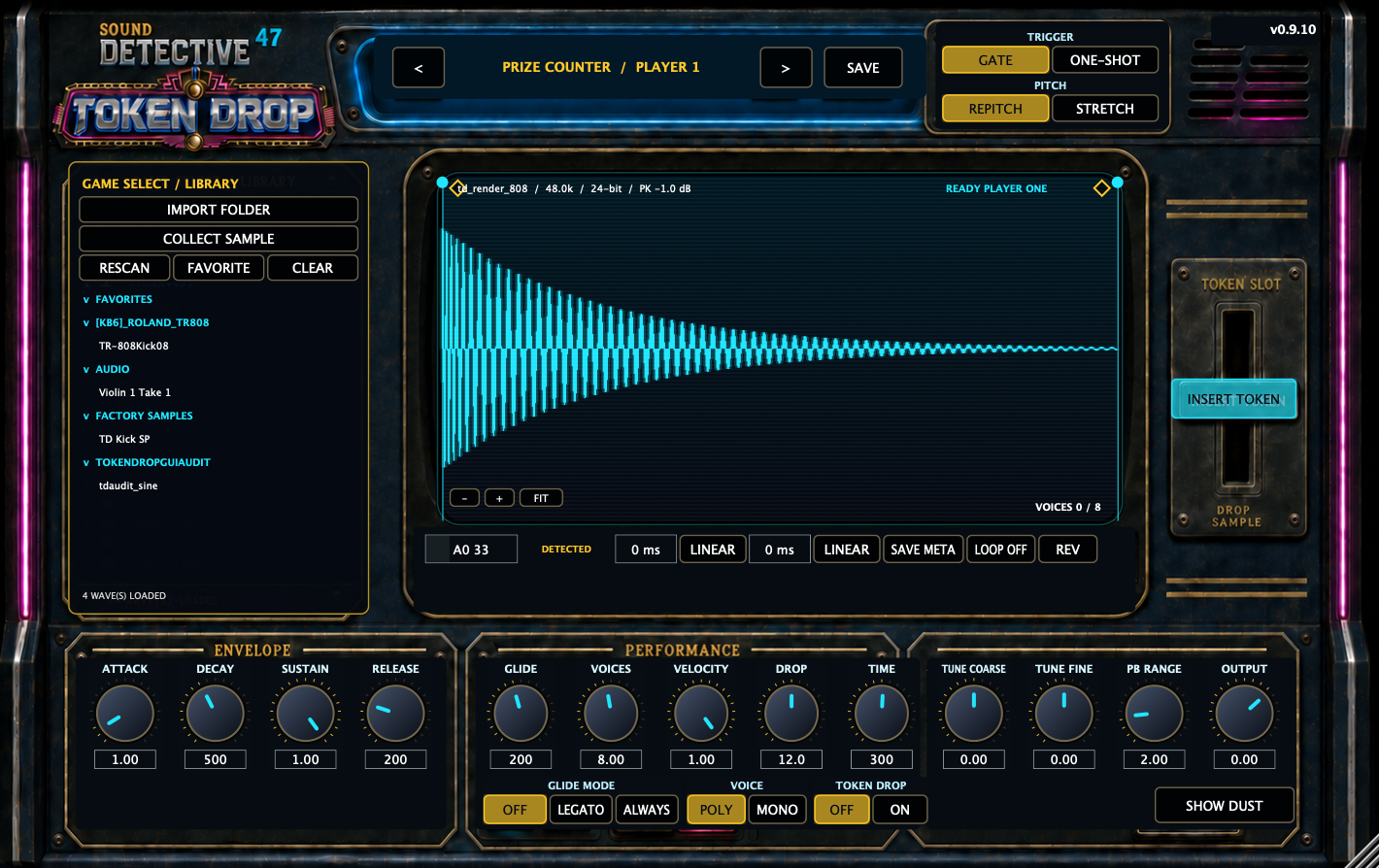
Every producer has a folder of great one-shots stuck at one pitch. Turning one of them into something you can actually play means opening a full sampler, mapping zones, hunting for the root note, fixing the aliasing when you play it high — all for a single sound. Token Drop makes it one move: drop the token in, play.
Three exhibits, one rule: the original one-shot, then a part played on it through Token Drop — named for the factory preset that makes it.
A single kick, then a whole 808 line played on it — glides, drops and all.
One vocal syllable, then a melody played across the keys.
A clean bell hit, then chords played through the 12.47 core.
The exhibits are being printed at the studio now — they land here as they're finished.
One cabinet, six boards — from the operations manual.
Any sample, playable chromatically the moment it lands. The root note is read from the filename or detected from the audio itself — and when a take has no single pitch it says so instead of guessing. Pick your pitch physics: REPITCH speeds up and slows down like the classic machines, with an anti-alias filter that keeps high notes clean; STRETCH keeps the hit its original length all the way up the keyboard.
GLIDE slides between notes — Legato for slides only where notes touch (butt them together in the piano roll and they slide), Always for every note. DROP is the signature move: every hit pitch-falls into the floor, an octave over 300 ms at the defaults.
Drag the trim around the part you want, shape it with fade curves, flip it with REV for risers out of silence, and hold it forever with LOOP — the loop point is found for you where the sound still has body, or dragged by hand. None of it touches your original file.
The lo-fi engine from Dust 12.47, built into the cabinet: bit depth with Warm or Hard Bits, sample-rate reduction, Drive, and filters. DUST MIX blends the crushed path under the clean one — clean sub, dirty top, no send needed.
Import a folder once and everything in it is browsable inside the plugin forever, by category, with favourites. Drag samples in from Finder, Cubase MediaBay, or the Cubase project window. COLLECT SAMPLE copies whatever you're playing into your own library with its root, trims and loop saved. Moved a file? The missing-file service finds it again.
Record a performance straight to disk with VAULT REC, print the current sound at its root with PRINT TOKEN, or PRINT KIT: eight pitched files in a folder, ready to load as pads 1–8 on an S2400. Always 48 kHz; 16-bit stereo by default.
Eight factory tokens ship in the cabinet, each built on a royalty-free sample made for Token Drop and each showing off one move: 808 Bass, Dead Drop 808, SP1200 Kick Bass, Linn Snare Lead, Chip Pluck, Arcade Organ, Fairlight Vox and First Crush Bell. Scroll the Prize Counter past either end and PLAYER 1 — your own session — is waiting where you left it.
808 slides without overlapping notes: Legato glide, notes butted together in the piano roll.
DROP on, trigger One-Shot: every hit falls an octave and rings out regardless of note length.
DUST MIX at 30–50%: the crushed signal sits under the clean one — instant grit without a send.
Eight field techniques ship in the manual, from “The Butt-Joint Slide” to “Collect Before You Archive.”
$29
One-time purchase. No subscription.
One-time purchase, no subscription. Your licence code arrives the moment payment clears and works on two computers. 14-day refund.
No — on purpose. Token Drop plays one sample at a time across the whole keyboard, the way the classic one-shot machines did, and makes that one sound as playable as possible. Your library of one-shots becomes a library of instruments.
No. The 808 workflow is one use — kicks, vocal chops, textures, bells, found sounds all play the same way. The root note is detected for you, and the anti-alias filter keeps high notes clean.
Yes — from Finder, from Cubase MediaBay, and from the Cubase project window. Project-window drags need the project’s audio folder imported into the Token Drop library first, because Cubase only sends the file’s name.
Not yet — a public trial follows the same road as Dust 12.47, and the case file list hears first. At $29 it’s also covered by the 14-day refund.
AU and VST3 instrument for macOS on Apple Silicon today. Anything beyond that gets announced when it’s true.
The full operations manual is already published — read it here.
Token Drop is running in real sessions right now. The case file list hears new evidence and every update first — $29, one-time.