Dry Vocal vs Automatic Throw
A lead line, then the same take with delay and verb blooming only at the ends of phrases.
New Case — Open
v0.9.6 · Free 14-day trialThe oldest move on the console, automated. Engineers have always ridden a send fader up as the singer stops — the throw that blooms into the space after the line. Getaway Driver does the riding: it hears the phrase end, opens the throw, and ducks out of the way when the voice comes back. No more automation drawn by hand on every pass.
Or take both edges of the phrase: Getaway Driver + Backtrace for $79.
macOS 12+ · Apple Silicon & Intel · Windows 10/11 (VST3) · AU + VST3
Throws are the most human trick in mixing — and the most tedious: automation drawn after every phrase, redrawn after every revision, on every vocal track in the song. Getaway Driver replaces the fader-riding with listening. You set the character of the getaway; it decides the timing, every time, exactly on the phrase.
Three exhibits, one rule: the dry take and the same bars through Getaway Driver — level-matched, one switch apart, named for the factory preset that makes it.
A lead line, then the same take with delay and verb blooming only at the ends of phrases.
A dry verse with echo throws landing on the last word of each bar.
A clean riff whose gaps fill with tape-chased repeats.
The exhibits are being printed at the studio now — dry/wet pairs land here as they're finished. The trial has all of it today.
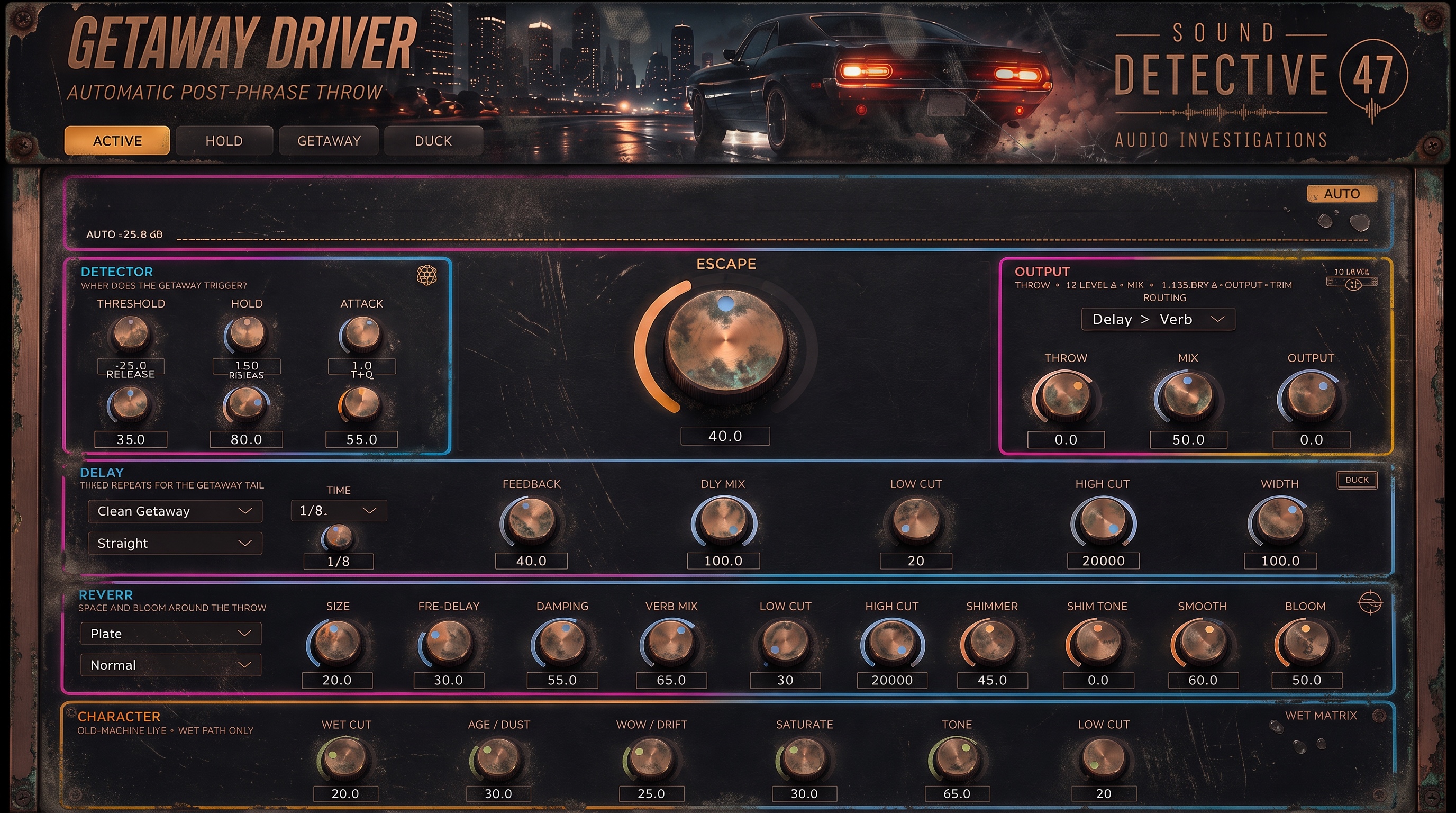
The detector, the hero macro, two racks, and the console. (The published manual documents an earlier build — the GLOVEBOX and the Air verb are newer than it.)
A smoothed envelope follower with hysteresis and a hold-confirm listens for the real end of a phrase; an armed latch means a silent track can never fire a ghost throw, and hitting stop never reads as a musical rest. The detection scope shows the input, a draggable threshold line, and status lamps so you always know why it fired — or didn’t.
One knob from subtle post-phrase ambience to a full cinematic getaway: it scales throw level, reverb size, feedback, and stereo width together, tuned so it never reads as just louder and never runs unsafe.
Clean Getaway plus six character machines — Reel Echo, Digital Pedal, Magnetic Drum, Tape Witness, Cold Rack, Vault Delay — all level-matched, synced from 1/1 to 1/16 triplet at host tempo (or free milliseconds), in Straight, Ping Pong, or Motion patterns.
Plate, Shimmer, Room, Dark Verb, and Air behind one Size knob with per-flavor size and decay mappings — plus verb FX modes: Normal, Reverse, Gated, and Swell. Flavor switches crossfade equal-power, never a jump.
Five pitch-shifted shimmer characters — Velvet, Choir, Halo, Glass, Air — with INTO VERB feeding the octave layer back into the tank to be re-diffused, so it blooms as part of the space instead of sitting on top of it.
Dust 12.47-lineage wear on the wet path only: a CHARACTER amount macro over Age/Dust (wear plus a wet-gated hiss bed), Wow/Drift pitch movement, Saturate, and Tone. The dry vocal stays clean; the echoes age.
Duck pulls the throw out of the way the instant the next phrase starts; Tail sets how long the getaway lives. GLOSS OVER is the one-knob finish at the end of the wet path — polish with an automatic low-pass that keeps bright tails from going brittle.
Always on, never audible until needed: bounded feedback that parks at a ceiling instead of running away, a wet limiter, a sub guard, and a watchdog with an on-panel GUARD counter. The unit is built so a throw can never take the mix down with it.
Twelve factory routes ship as host programs, each a complete starting point that never touches your gain staging or threshold: Stock Getaway, Cruise Control, Open Road, Night Drive, Canyon Run, Lane Change, Ghost Trail, Fog Bank, Dub Alley, Rear View Mirror, Roadblock, and The Tailgater.
High feedback, tape machine, hands off — the classic dub throw with the safety chain holding the ceiling.
Automate one knob across the song: verses dry, choruses opening, the bridge a full getaway.
Any verb flavor, any voicing — INTO VERB folds the octave bloom back into the space.
The manual’s FILE 09 carries eight of these moves, from “The Dub Getaway” to “The Rhythmic Gap-Fill.”
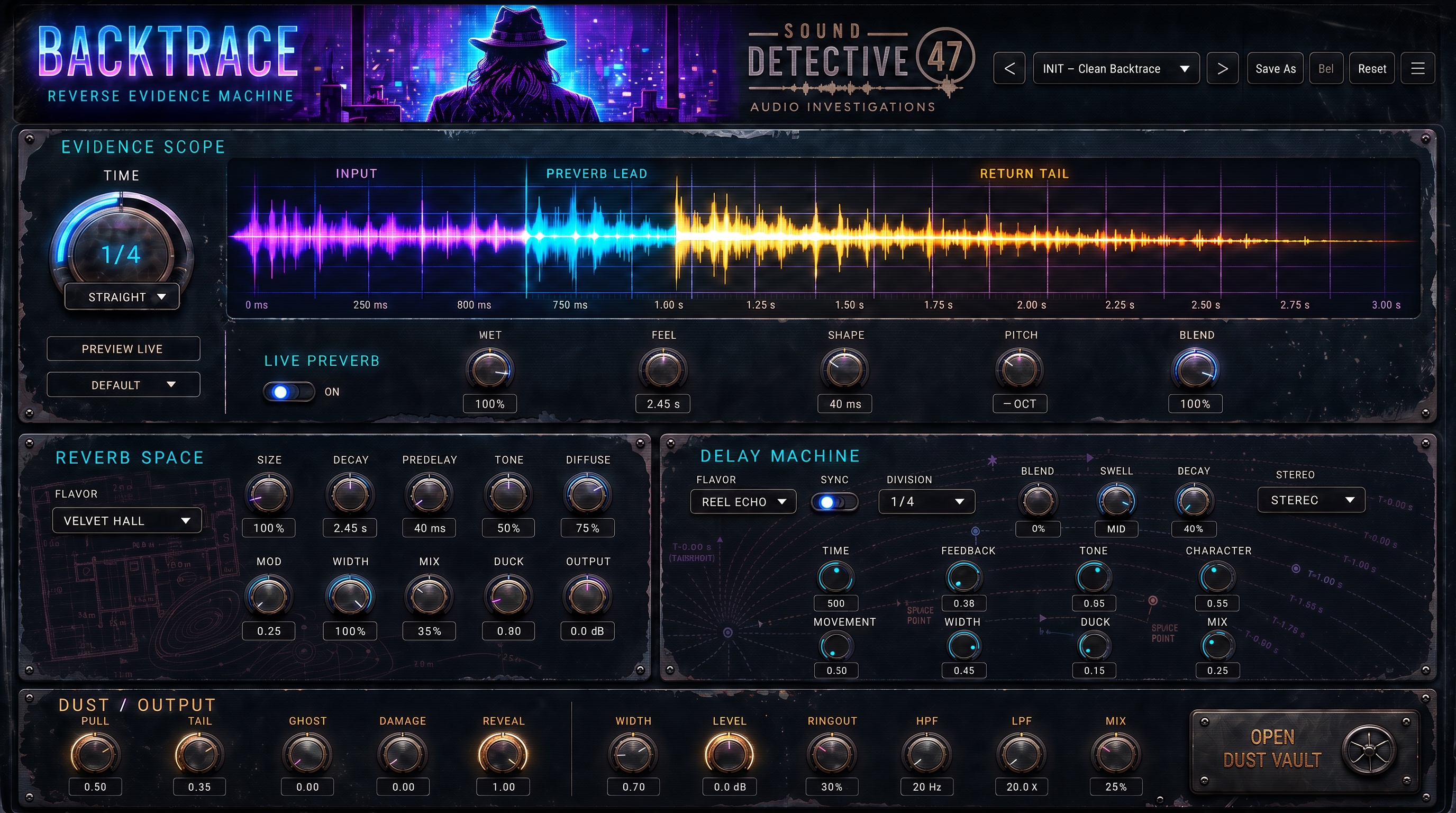
Getaway Driver works the back of the phrase — the throw that blooms after the line ends. Backtrace works the front — the reversed rise that leads the voice in. Together they own both edges of every phrase in the arrangement.
$79
for both · instead of $98 · you keep $19
One checkout, two permanent licences — each for two of your Macs.
$49
One-time purchase. No subscription. Or both edges for $79.
One-time purchase, no subscription. Your licence code arrives the moment payment clears and works on two computers. 14-day refund.
Ducking reacts to level; Getaway Driver detects the end of a phrase — hysteresis, hold-confirm, and an armed latch — then opens a complete throw: delay machine, verb flavor, shimmer, and character, timed to the gap. Ducking is one piece of it, not the trick.
Add it to your cart from this page. $49 on its own or $79 with Backtrace, one-time; the licence code arrives the moment payment clears. Not sure yet? The free 14-day trial is the full plugin.
Yes — it’s open now. One email unlocks a signed, notarized Mac installer; fourteen days with the full plugin, every control live. Take the case.
It builds as VST3 and AU for macOS today. Anything beyond that gets announced when it’s true.
The full operations manual is already published — read it here. (It documents an earlier build; the GLOVEBOX and the newest verb flavor are ahead of it.)
Getaway Driver is running in real sessions right now — and the free trial is open now. $49 on its own, $79 with Backtrace.